The word makes it sound like a glitch, an occasional trip. That framing is the mistake. For a business putting an LLM in front of customers, employees, or financial decisions, hallucination is not an edge case to laugh off, it is an operational risk with a known rate, known trigger conditions, and a known set of controls, the same way a payment system plans for fraud rather than hoping it will not happen. The rate is measurable, and so is the trade behind it: on one OpenAI evaluation, two models scored near-identical accuracy while one almost never declined to answer and was wrong 75% of the time, against 26% for the one that abstained on half the questions (OpenAI, “Why language models hallucinate”).
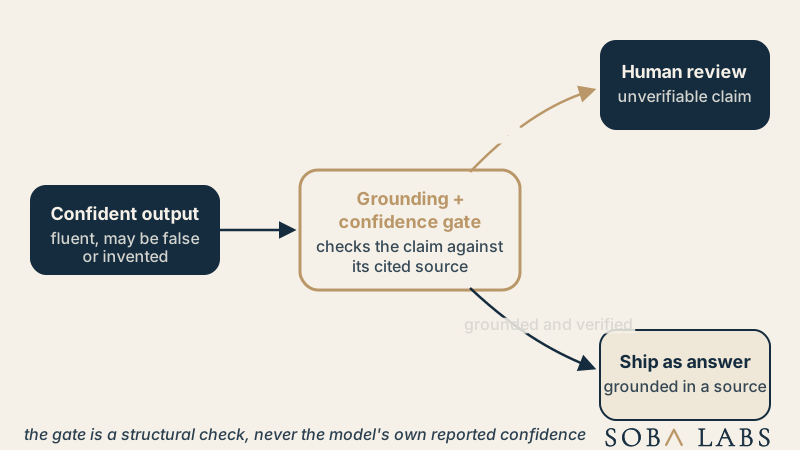
Hallucination is not a party trick to marvel at. It is a production risk you gate, measure, and design around, the same discipline any regulated process applies to human error.
Where does hallucination actually show up in a business system?
Anywhere a model is asked a question its sources cannot actually answer: a policy detail that was never written down, a number outside the retrieved documents, a customer history the system was not given. The model does not know the difference between an answer it retrieved and an answer it invented, so a support agent quoting a refund policy that does not exist, or a research assistant citing a study that was never published, are the same underlying failure wearing different clothes.
Why does grounding reduce it without solving it?
RAG helps because it forces the model to answer from retrieved text instead of pure memory, and citations let a person check the claim against its source. It is not a fix on its own: retrieval can return the wrong passage, the model can misread a correct passage, or it can blend a retrieved fact with something it half-remembers from training. Grounding lowers the rate; it does not lower it to zero, which is why a hallucination strategy needs a second layer beyond retrieval.
What actually catches a hallucination before a customer does?
Not asking the model to rate its own confidence: that self-report is poorly calibrated and clusters near certain even when wrong, a finding detailed in why self-reported confidence is not a reliable signal. The controls that hold up are structural: guardrails that block a class of unverifiable claims outright, a human approval gate on anything consequential, and citation checks that verify a claim actually appears in the source it names, not just that a source was attached.
What should a company actually do about it?
Decide the acceptable error rate per workflow before building, the same way a fraud team sets a tolerance rather than aiming for theoretical zero. A drafting tool that a person reviews can tolerate a higher rate than a system that emails a customer unattended. Our AI readiness assessment scores exactly this tradeoff for one workflow: whether the data and review points exist to run an LLM-based system at an error rate the business can actually live with.