The transformer architecture and its attention mechanism power most modern LLMs, while tokenization converts input into the units they process. What a buyer actually needs to know is narrower and more consequential: what can this thing be trusted to carry once it sits behind a real workflow, touching real customers or real records.
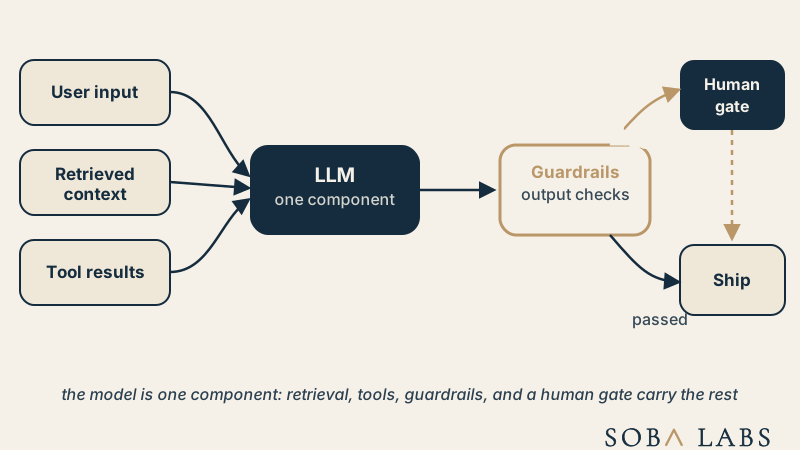
An LLM is a component, not a product. Every reliable system we have shipped puts retrieval, tool access, and a human gate around the model, never the raw model in front of a customer.
What can an LLM actually be trusted to do?
It is excellent at the tasks language models are built for: drafting, summarizing, classifying, extracting structure from messy text, and reasoning in natural language over whatever sits in its context window right now. A multimodal LLM can also process images, audio, or video. The model has no memory of your company between calls and no built-in way to verify a claim against a source, which is why a plain LLM answering questions about your business will eventually state something false with total confidence, the failure mode covered in hallucination.
Where does an LLM stop and a real system start?
An LLM only knows two things: its training data, frozen at a cutoff date, and whatever text you put in front of it this turn. Anything current, private, or company-specific has to arrive through RAG, which retrieves the right documents before the model answers, or through tool calling, which lets the model query a live system directly. Most production deployments use both: retrieval for facts, tools for actions, and the model as the reasoning layer that decides which to reach for.
What does an LLM cost, and how is that measured?
Cost and latency scale with how much text goes in and out, measured in tokens, and with how large a context window the request uses. A system that stuffs every available document into every prompt is not more accurate for it; it is slower, more expensive, and more likely to bury the fact that actually matters. This is the practical argument for retrieval over brute force: pull in the few passages that answer the question, not the whole knowledge base.
When is a bare LLM the wrong choice for a business?
Treating an LLM as a finished product, a chat box with no retrieval, no tool access, and no verification step, is the fastest way to ship something that reads confident and is quietly wrong. A confidence score the model reports about itself is not a reliable gate; production systems need a deterministic check instead, a pattern detailed in why self-reported confidence is not a reliable signal. Our AI readiness assessment scores exactly this question, whether a workflow has the data and guardrails an LLM-based system needs before it touches real work.