What are the four dimensions, concretely?
The verdict is not one number pulled from a vibe. It is four separate signals about the same workflow, scored on their own terms and then combined, shown below.
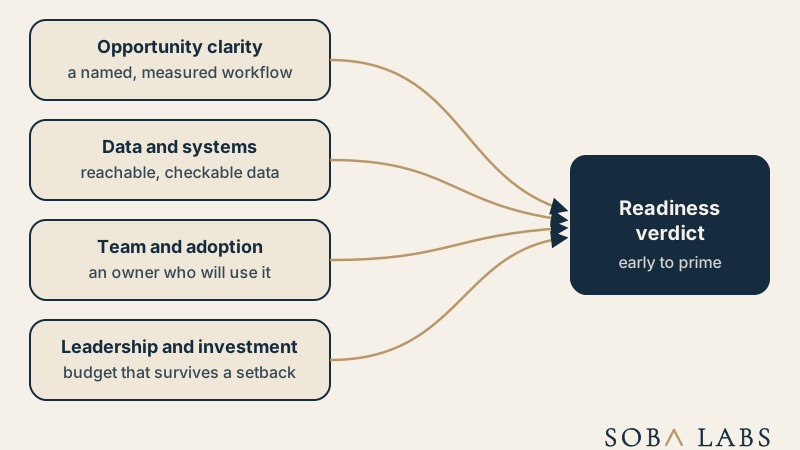
Opportunity clarity asks whether the problem is specific and measured, not a general sense that “things are slow.” Data and systems asks whether the workflow’s inputs can actually be reached and whether its output has a checkable definition of correct. Team and adoption asks whether a named person owns the change and whether the people doing the work today will actually use what replaces part of it. Leadership and investment asks whether budget exists and, more tellingly, whether it survives the first setback rather than evaporating at the first rough week. A workflow only earns a high score by clearing all four, not by being strong on one and weak on the rest. A company-wide AI maturity model asks the same questions of the whole organization instead of one workflow.
AI readiness is not a company score. It is whether this one workflow, specifically, is ready to become software.
Why does readiness belong to the workflow, not the company?
Most frameworks score the organization: culture, governance, a maturity curve on a slide. That buries the real question a builder actually needs answered. A company can be behind on agentic AI generally and still have one workflow, an intake queue, a document review step, that is ready to become an AI agent this quarter, while a mature AI program still carries three other processes that are not ready at all: undocumented, contested ownership, no budget past the pilot. Scoring the company instead of the workflow hides exactly the variance that determines whether a build succeeds.
How does a weak dimension actually sink a build?
Each dimension fails differently, and the failure shows up after the build starts, not before. Weak opportunity clarity produces a system nobody can tell whether it worked, because the target was never measured. Weak data means the agent cannot reach what it needs or has no way to check its own output, the exact gap covered under context engineering. Weak adoption means a technically correct system sits unused because the people closest to the work were never brought in. Weak leadership backing means real work gets built, works, and then gets starved of the next iteration the moment something else competes for budget. The four dimensions exist because these are four separate ways a project dies, not four ways to phrase the same risk.
How long does it take to check, and what happens after?
Our free assessment scores one workflow across all four dimensions in about twelve questions, roughly two minutes, and returns an honest band: early, emerging, ready, or prime, plus the weakest dimension and three concrete next actions. A result that lands in the early band is not a rejection; it is a shorter to-do list than a stalled build would have cost. A workflow that scores ready or prime is the signal to scope a fixed-price first build against a measurable outcome, the same discipline behind why coding stopped being the bottleneck: the constraint was never whether the model could write the code, it was whether the workflow around it was actually ready to receive it.