For a business leader, the practical question is rarely “can AI do this.” It’s whether a given process should run as a fixed script, an unattended agentic workflow, or stay a job for a person. The diagram below shows why that choice matters: the same trigger runs through a completely different shape depending on which one you pick.
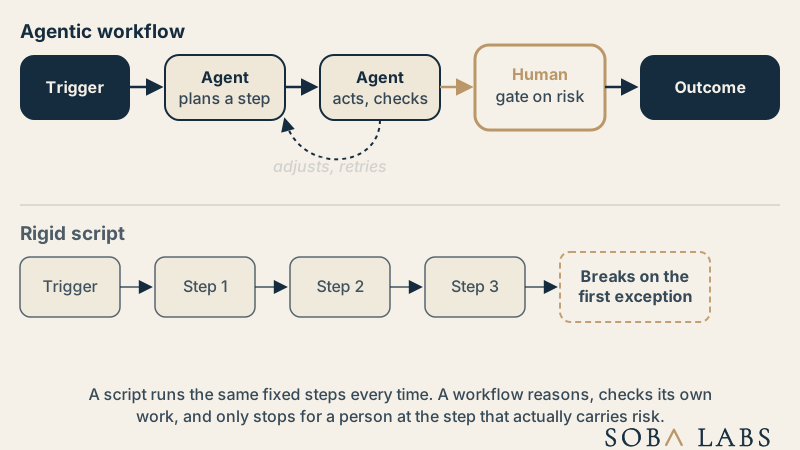
A script executes steps. An agentic workflow pursues a goal, and only stops to ask a person when the next step actually carries risk.
How does an agentic workflow actually differ from a script?
A rigid script runs the same fixed steps in the same order every time, and breaks the moment reality does not match what the author anticipated: a field is missing, a system is down, an exception nobody wrote a branch for. An agentic workflow reasons instead of just executing: the AI agent inside it decides the next step from the current state, checks whether that step actually worked, and adjusts rather than crashing, the same loop covered under agentic AI.
Where does the human gate actually belong in the workflow?
Not at every step, and not nowhere. The gate sits right before the action that is expensive or hard to reverse if the agent got it wrong, exactly the placement problem covered under human in the loop. Everything upstream of that point, reading records, drafting a response, checking a policy, can run unattended; the step that sends, pays, or changes production data is where a person’s sign off earns its cost.
What kind of business process is actually worth turning into one?
Work that is too varied for a script but too repetitive to keep paying a person to do by hand: triaging inbound requests that never arrive in quite the same shape twice, reconciling records across systems that were never built to talk to each other, drafting a first pass at something a person then reviews. A process that already runs the same five steps every time gets no benefit from an agent’s reasoning, that is what plain automation is for, and building an agentic workflow anyway just adds unpredictability where none was needed. Before committing engineering time, our AI readiness assessment scores exactly this question for one workflow: is the process variable enough to need judgment, and is the data clean enough for an agent to act on.
Does an agentic workflow replace the team running the process today?
Rarely, and treating it as a headcount swap is usually the wrong frame. Larger workflows often split the reasoning across an orchestrator delegating to several workers rather than one generalist trying to hold the whole job at once, but the shape of the trade stays the same either way: the workflow takes over the repetitive middle, reading, deciding, acting on the routine cases, while the person’s time moves to the judgment calls the gate surfaces. The win is not fewer people watching the process, it’s the same people spending their time on the parts that actually need them.